.png)

Victoria has a proud history of gold production stretching back to 1851. Since that time, 80 Moz of gold has been produced in Victoria from world famous locations such as Bendigo, Ballarat, Castlemaine, Stawell and Woods Point.
SXGC's properties also hosted high-grade gold production in the 19th and 20th centuries.
Here we discuss a brief history of production and exploration at each of our Victorian properties.
Sunday Creek (then known as Clonbinane) is reported to have produced 41,000 oz gold at a grade of 33 g/t gold between 1880-1920 over a greater than 11 km trend. The previously mined surface workings were shallow, the deepest shafts reaching only 180 m down at their lowest point whilst the most recent drilling in the 1990's-2000's concentrated on oxide opportunities only down to 80 m.
Redcastle was discovered in 1859 (then known as the Balmoral Diggings) where mining continued to 1902. Total primary gold extracted from the Redcastle diggings was around 35,000 oz at 33 g/t gold. The maximum depth across the 24 historic mining areas and 17 km of mineralised veins at Redcastle was only 125 m. Modern exploration before the arrival of SXGC comprised of rock chip sampling, soil geochemical surveys and very shallow drilling for an average depth of only 40 m.
The trend at both properties? High-grade historic workings but untested at depth!
The Victorian goldfields have entered a new golden age. Through the use of modern technology, companies such as SXGC are returning exceptional results at prospects that have never before been drilled to depth such as those in our portfolio.
Through disciplined and methodical uses of exploration technology, SXGC is successfully finding high grade gold and antimony mineralisation at its properties in the Melbourne Zone of central Victoria.
SXGC is positioned to become a great Australian gold story. With three highly prospective properties at historic goldfields in central Victoria, SXGC is at the forefront of a new era in Australian gold exploration.


We are grateful for the use of these photos supplied courtesy of the Wandong History Group. www.wandongheathcotejunctionhistory.com.au
We would like to thank local self-titled 'amateur historian' Trevor Viénet for the following comprehensive histories of the Sunday Creek property and region, the historic mines and local families. They are a fantastic record of our industrious predecessors in the region who we recognize as giving us guidance to the riches below the surface and we honour their efforts on this page.
16 kilometres upstream on Sunday Creek is the selection known as Clonbinane Park. McKenzie owned the property, and it was not long before the area was known as Clonbinane. Among the early settlers to this pristine valley were Jenkins, Smedley, C. Ryan, Burne, Teakle, Sherlock and Mrs Kenny.
Ryan Brothers (No relation to above C. Ryan) had found alluvial gold in Sunday Creek. This was before 1880, instead of finding their misplaced horses they found what was described as a reef of gold. This turned a quiet rural setting into a place of great activity as people arrived to make their fortune.
This was the start of the Clonbinane township and the 140-year history of gold mining in the area.
It was not only Clonbinane that started to boom. Reedy Creek diggings commenced a decade earlier and by 1872 there were 60 miners and their families living in Reedy Creek. By the time Clonbinane was popular, Reedy Creek had a population of hundreds including many Chinese. There were many goldfields throughout the forest over the years. Some were small villages that only lasted whilst gold was being found. Some of these are-
The Ryan brothers dug shafts and a tunnel; however, they were hampered by water entering the shafts. This limited the depth to which they could dig. They used a water wheel to drive their ore battery and diverted water via a water race for 2.4 kilometres from the upper sections of Sunday Creek.
A company named the Golden Dyke took over the mine and sank a shaft on the same site. Up to date machinery enabled them to pump water from the mines, which reduced some of the issues with flooding. A shaft was sunk to 210 metres with five drives, one being 1.6 kilometres in length.
The early stages of the mining development at the Golden Dyke attracted many miners, mainly due to their reputation of paying well. It did not take long before a village formed filled with wooden huts and houses. There was a hotel, a wine shanty, sly grog shop, a billiard parlour, two stores, Searle’s Butchers and a post office. Mail came via Wandong. The first state school was formed, No.1653. It had an attached teacher’s residence. The school was the centre of the community and used for most events including entertainment and church services. The school was about two kilometres from the village near today’s Smedley Lane. It was later moved to a site in Clonbinane Road, near Hibberds Lane. When you drive down Clonbinane Road you may notice the Elm trees on the east side before you reach Hibberds Lane.
Social events and music nights were popular. Mr Robinson of Glenburnie Park (Near Spur Rd and the original Magpie and Stump Hotel) generously hosted an annual picnic for the school children and their families. The school was not a small rural school; it boasted an attendance of 68 children.
Clonbinane was also a sporting town providing tennis, football and cricket teams. The big annual event was the sports meeting. These annual events were very popular in the country and Strath Creek managed to continue the tradition for many years.
The Golden Dyke was in full swing when another mine was established. The Apollo when opened proved to be unprofitable as was a third mine named The Christina. It was located on the west side of Sunday Creek. Both these mines have been opened and closed several times over history in search of gold as well as antimony. It is not only gold at this location, but Antimony is also mentioned in the Kilmore Press article of 1894. The need for antimony in WW2 kept the Apollo Mine busy and the processing was conducted at Costerfield. However, worked ceased without any substantial results as the war ended and priorities were elsewhere.
The closure of the Golden Dyke forced miners to move away in search of other work. The adjoining mining lease was held by R. Teakle.
Charles Smedley (Born 26/3/1891), son of Thomas Smedley and Lucy Sharp, is a grands on of William and Margaret (Ward) Smedley that were married in 1850. William Smedley was a sawyer, and Margaret was an Irish orphan. She had been apprenticed as a dairy maid in Flinders Lane Melbourne. William and Margaret settled on a property which is at the end of Hibberds Lane. They had an orchard on the creek and William continued with his skills at cutting timber.
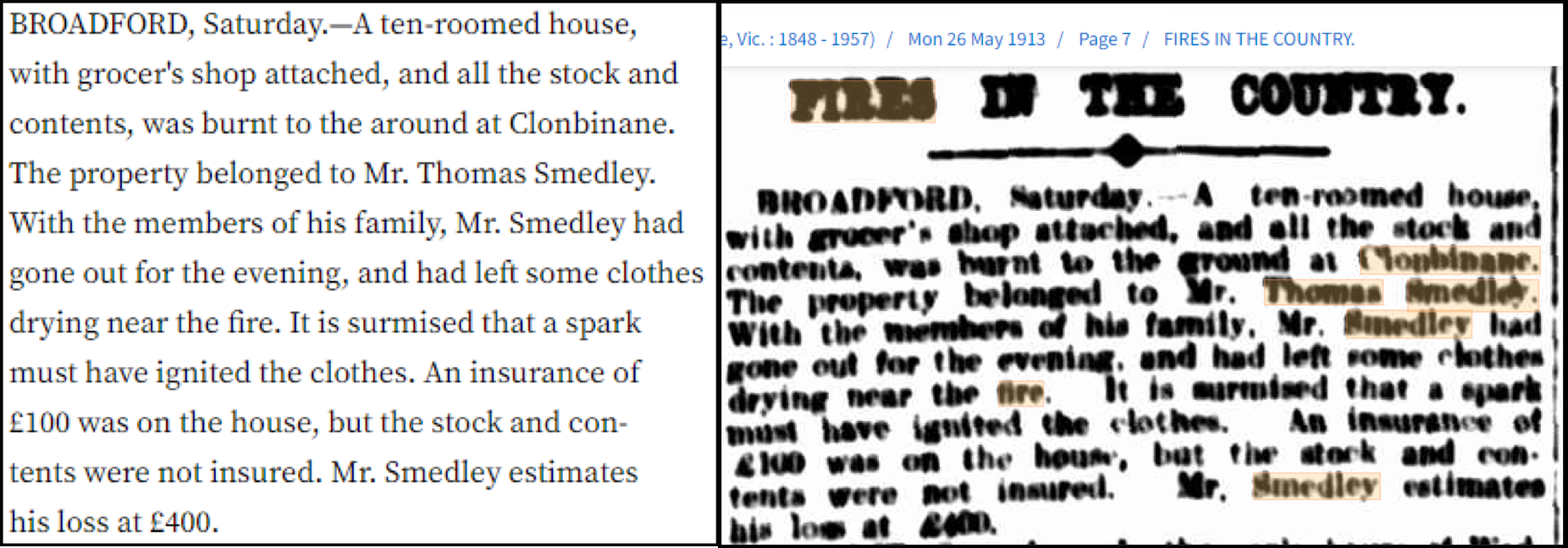
Their son Charles Smedley married Mabel Bennett and fortunately she wrote some history on Clonbinane and in later years made the map of Clonbinane Village, with Charles’ help to remember the who’s who and where their homes were situated. Charles’ parents, Thomas Smedley and Lucy Sharp moved to Clonbinane in 1878 just before the population boom in the village. They ran a store in the village. The store burnt down in a house fire in 1913. Thomas also worked in the mines and supplemented income with some farming.
Young Charles Smedley left Clonbinane School in 1903, at the age of 12 to cut wood with his father and brother Bill. He later worked the battery at The Golden Dyke for a short period as a thirteen-year-old. When the mine closed in 1904, Charles made eucalyptus and ran cows for the next five years. At the age of 18 he and T.M. Neill took a bullock team to Swan Hill and then to Chillingollah to start a sawmill.
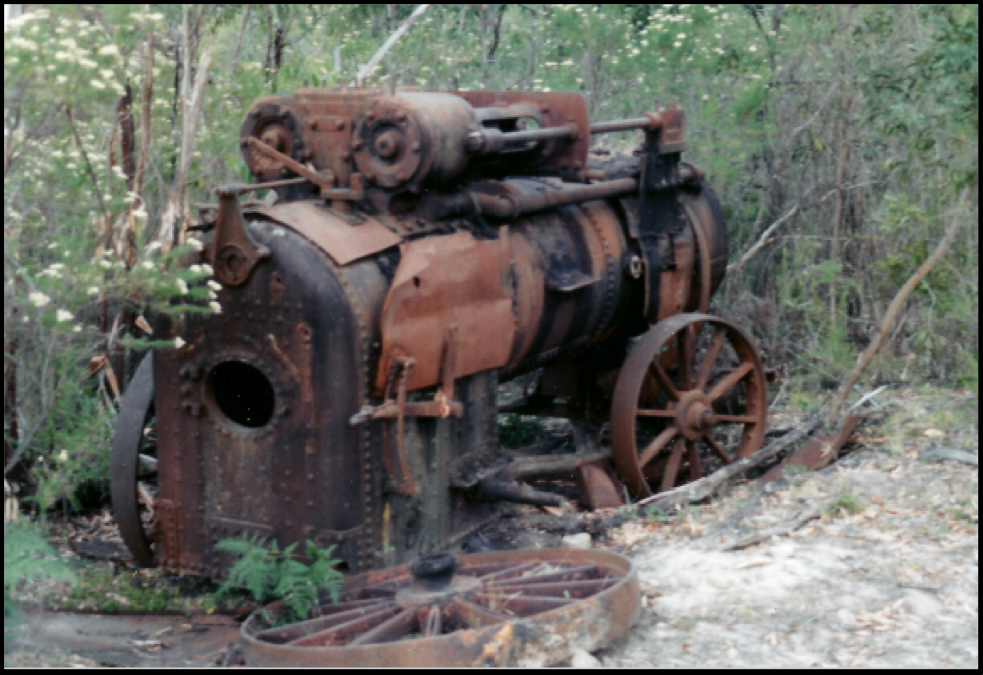
In 1915, Charles Smedley at 24 years old was enlisted and served in WW1 on the Somme in France. Returning in 1919 he worked at Glen Elgin (Clonbinane) on the Neill family property. Clonbinane was his home base. He worked on projects and put in tender bids such as building the Dry Creek Bridge in 1933, Broadford and Kilmore Reservoirs and in 1936 built the Tyaak Bridge. Whilst in the army he picked up some skills with explosives but more importantly gained a licence to operate steam equipment. He operated what we know as Smedley’s Engine, located on what was once part of the Smedley property on Stony Creek. The portable steam engine appears to have had its first mandatory steam boiler inspection on 30 January 1912; however we believe it may have been used on a paddle steamer on the Murray prior to that. Charles is believed to have used the sawmill on Stony Creek about 1938-1939. He would have been 48 years old at the time.
The engine was originally at Reedy Creek at Greens Mill. It is believed that Charles Smedley may have bought the portable steam engine from T.M. Neill where it was located at the Leviathan Sawmill on Leviathan Road near the old goldfield. That mill is recorded as operating 1936-1939. Incredibly the portable engine was lowered down the very steep Gentle Annie (Quarry Road from Spur Rd) to the current site, close to Stony Creek and Stoney Creek Road (Road name appears to be a mapping name error).
There is a lot more than just a rusting boiler to be found here, there is a clearing that was probably a loading yard, a trench that was the saw pit and there are there mains of a concrete weir in the Stony Creek. The boiler needed a supply of water, so a metre high wall was built across the creek.
According to Russell Searle’s research, this engine is a Marshal portable. He traced its Boiler Identification Number near the fire box door, it was owned by Greens of Reedy Creek, and when last used it was on lease to Jaques with the engine situated in Clonbinane. It was possibly originally a boat engine as its smoke box door is a bifold, not the normal swing out, and it has reversing gear, not normal on a portable. Although when Russell last saw it the lever and quadrant had been removed. This is probably the last surviving steam engine that worked at Reedy Creek.
Russell’s hypothesis is it may have been in a reasonable sized mill, as there is a trench running in line with the engine, possibly fora belt to under floor shafting. Jaques was a Richmond based company. They ended up building cable excavators. It was in that location for its last 2 boiler inspections. So, 2 to 3 years. It appears Charles Smedley was a busy and industrious man and may not have worked it full time considering his other interests. About 30 years ago some scoundrel stole the wheels and Russell reports other components have gone missing in recent years. (See the picture I took with wheels still intact). The Smedley Engine is situated on private land.
First inspection 30/1/1912 of the portable steam engine and the last inspection 13/8/37 before being moved to the Smedley property.
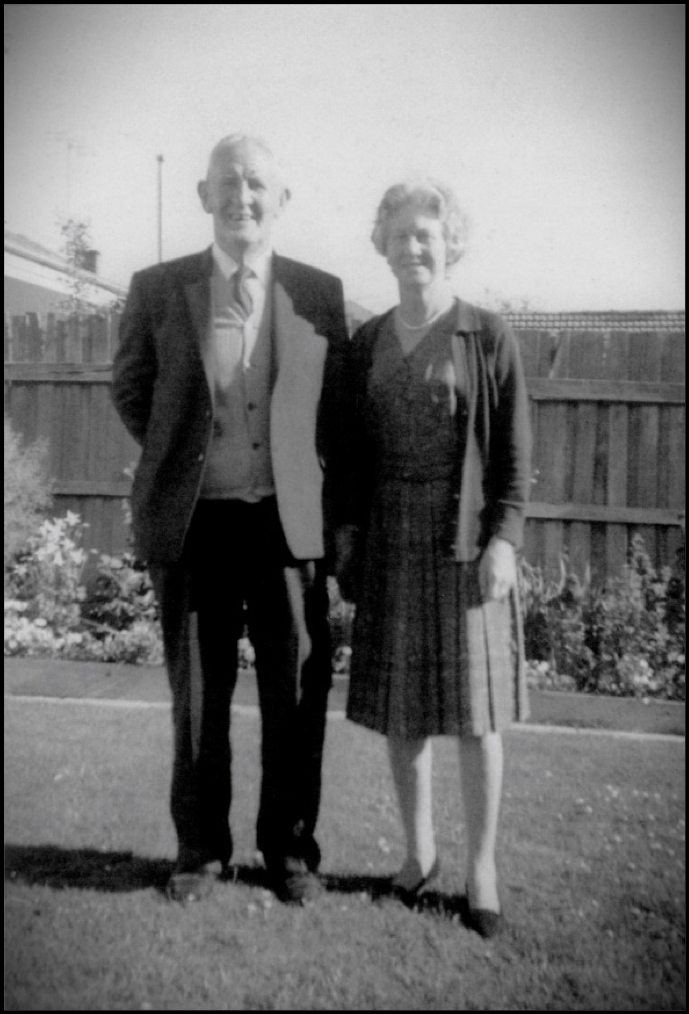
Charles and Mabel Smedley. Photo taken at Wangaratta about 1972.
Photo supplied by Di Vidal. Also appears in Alan Smedley’s book Clon and Beyond (A Smedley Story).
What mines, businesses and people are recorded as living in Clonbinane village? We have records of 82 households that indicate a permanent population of about 300 people in the village alone, however other sources indicate as many as 2000 people were in the Clonbinane area in the peak times of the gold rush era. Keep in mind that this was not the only gold mine settlement in the forest and people drifted between the different settlements.
Many thanks to Di Vidal for supplying information from her family (Smedley). It will be a useful source for a proposed chapter- History of Clonbinane In a book on Mt. Disappointment History. The chapter will in corporate families, mining, logging, the fire brigade and the Clonbinane State School.
The map was compiled by Mabel Smedley on information given to her by her husband Charlie Smedley in the early 1970s.
The residents listed were considered as permanent residents at the time the mud map was drawn. We would consider these people to be living in permanent structures rather than in tents. The list does not include the casual people that roamed between the goldfields of Reedy Creek, Tonsil, Germantown, Leviathan and Strath Creek. Other than the gold seekers, the forest also attracted people working in small sawmill settlements as well as the larger ones connected to Wandong by tramways.
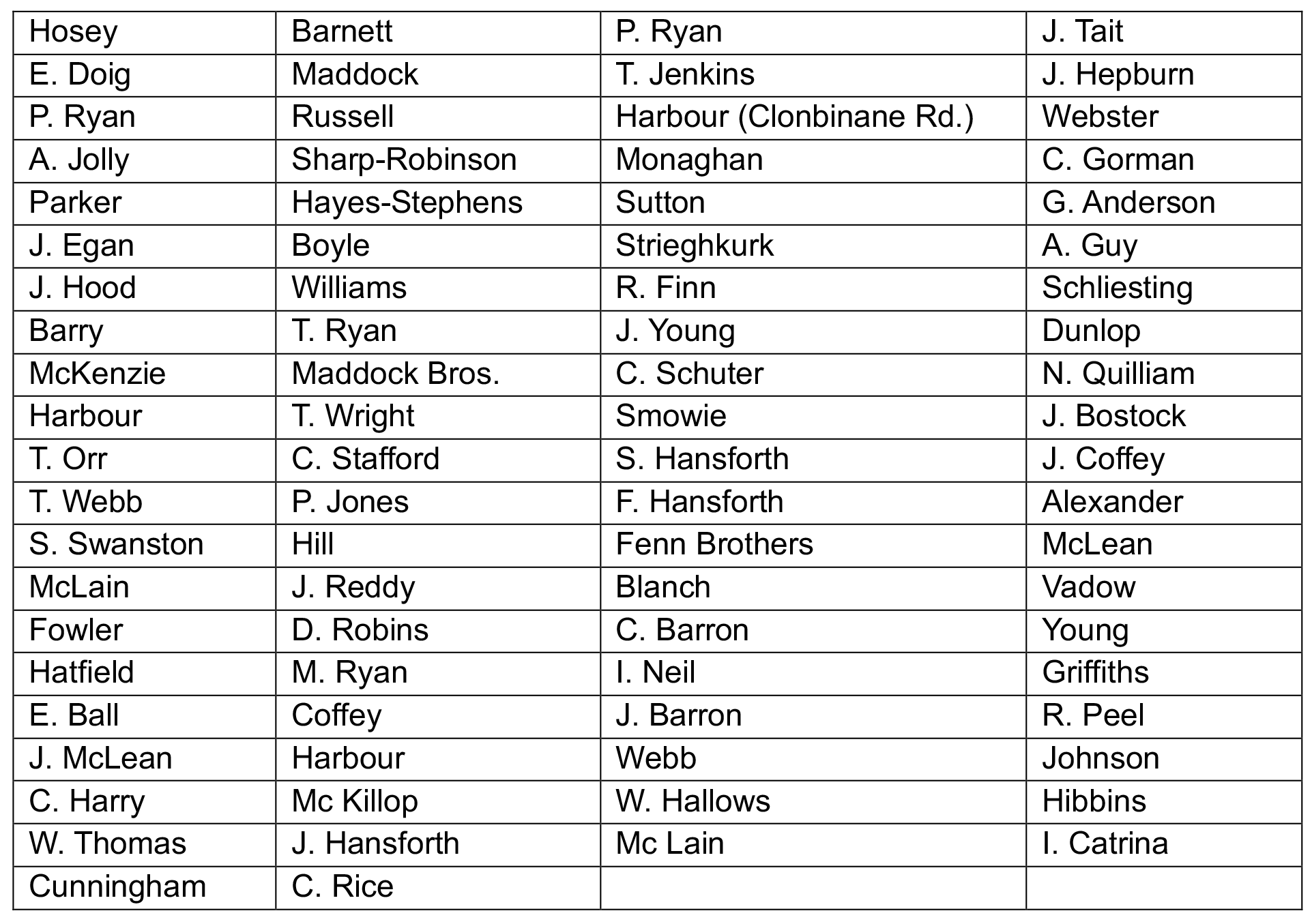
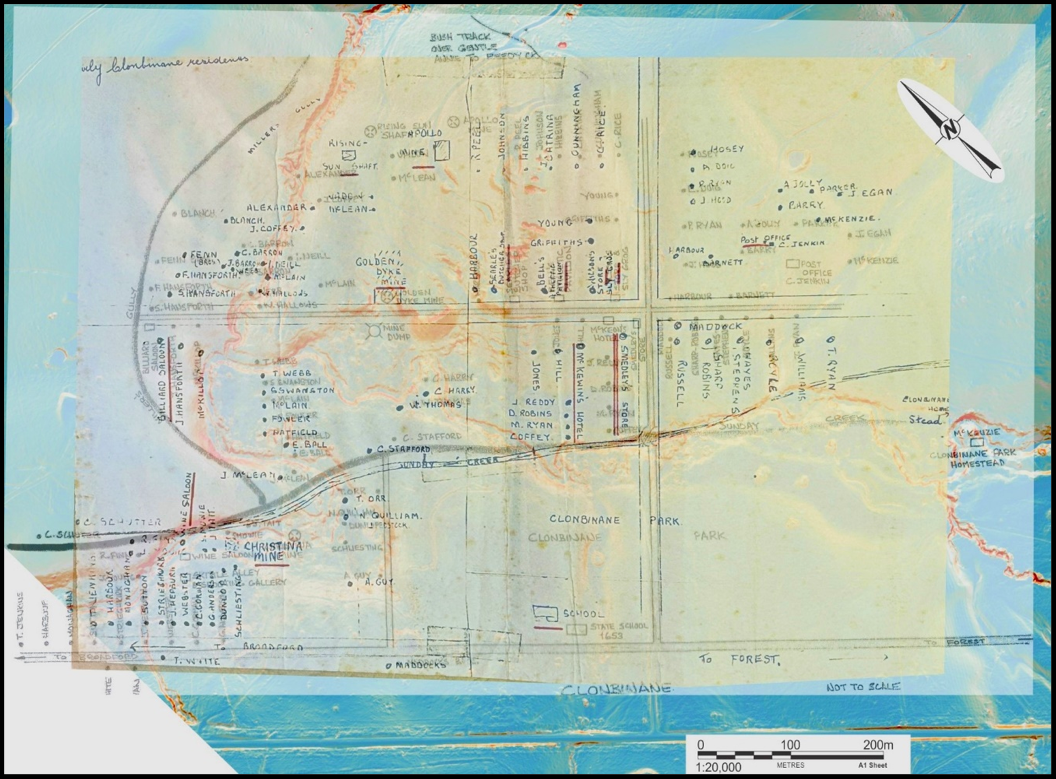
A map drawn of Clonbinane village by Mabel Smedley with help from Charles Smedley
130 years later we have similar discussions regarding exploration, gold mining and investment at Clonbinane. The names of the mines remain the same. Current exploration in the area is conducted by Southern Cross Gold (SXGC) on their land at Hibberds Lane Clonbinane. They have an exploration licence and their data from their results is promising. However, there is a big step in transition from exploration to mining. A Mining Permit is required and takes some time to acquire as the process of due diligence and protocol are followed.
Abbreviated excerpt from Thursday 25 Jan 1894, Kilmore Free Press (Kilmore, Vic: 1870 -1954)
By Pathfinder
There is a mining revival in the Sunday Creek district. It is usually a quiet and unfrequented spot. Now it is being searched in all directions for the precious metal.
Parties are daily arriving from the metropolis and elsewhere decked out in all the gorgeous panoply of the early Victorian digger, but whether or not their gorgeous appearance is to be accepted as a knowledge of mining is a very moot point-perhaps. If so, let us so hope and wish them success.
For the last 37 years mining has been carried in this district with relatively good results. Hanz the Swede has been credited with making thousands. No doubt he did very well indeed. He kept very secluded and led people to believe that he was keeping body and soul together and nothing more. Others did well and profited by it - selected land and settled down to live by the soil. More followed the glorious uncertainty of mining with persistency and sacrificed the fortune they already had in their anxiety to secure more. The country is dyke formation and requires experience to understand where to begin and where to knockoff. The peculiarity in all dyke formation is more strongly marked at Sunday Creek than in other districts I have visited, in as much as when leaving the alluvial and getting into the quartz, a combination of minerals is found and which at times is rather difficult to separate.
The Apollo Mine, now owned by Mr R. Beeston, is on the dyke, also the Christina, the former on the eastern and the latter on the western side. The gentleman named has made many futile attempts with the Apollo in his endeavours to separate the gold from the antimony, and has at enormous outlay to himself, erect one of the finest separation machines.
In the event of him not being able to treat the ore there it is his intention to start the Apollo and convey the ore to Costerfield for treatment. Had we a few more men with the same amount of go in them, Sunday Creek would compare favourably with many of the gold districts of the colony and prove a good investment with very little outlay.
It is one of the best watered plains I know of, and prospectors have no difficulty whatever in obtaining sufficient water for all purposes from Sunday Creek and its branches. In fact, water is a drawback as well as an advantage, and it is owing to too much water that the Christina mine is now idle. Here is a good mine and where it elsewhere would be looked upon as a fortune to its owner.
Why, I have seen some of the finest specimens taken from leaders at a depth of 40 feet, it has been my lot to look upon, narrow certainly, but rich enough to warrant improvement at greater depths. This mine has been idle for two years or more -want of capital, the bursting of the land boom and sundry other causes. It has been forfeited and re-pegged several times, but as yet nothing has been done in compliance with the labour covenants. It is hard to understand why so many extensions should be granted, and if applicants for forfeiture are bona fide, why should they not be compelled to make some effort to open up the mine, for it not where does the necessity for a change arise?
Since writing the above I hear of an application for the forfeiture of the Apollo lease, and I fail to see where justice would come in by doing so. I am quite convinced the present owner would be glad to meet the applicant and give him every assistance in his power and thus save unnecessary expense.
At a future time, I shall have more to say of the district, and in the meantime, I trust some of our speculators, who are seeking for good investment, will visit the place and see for themselves as to its being worth a trial.
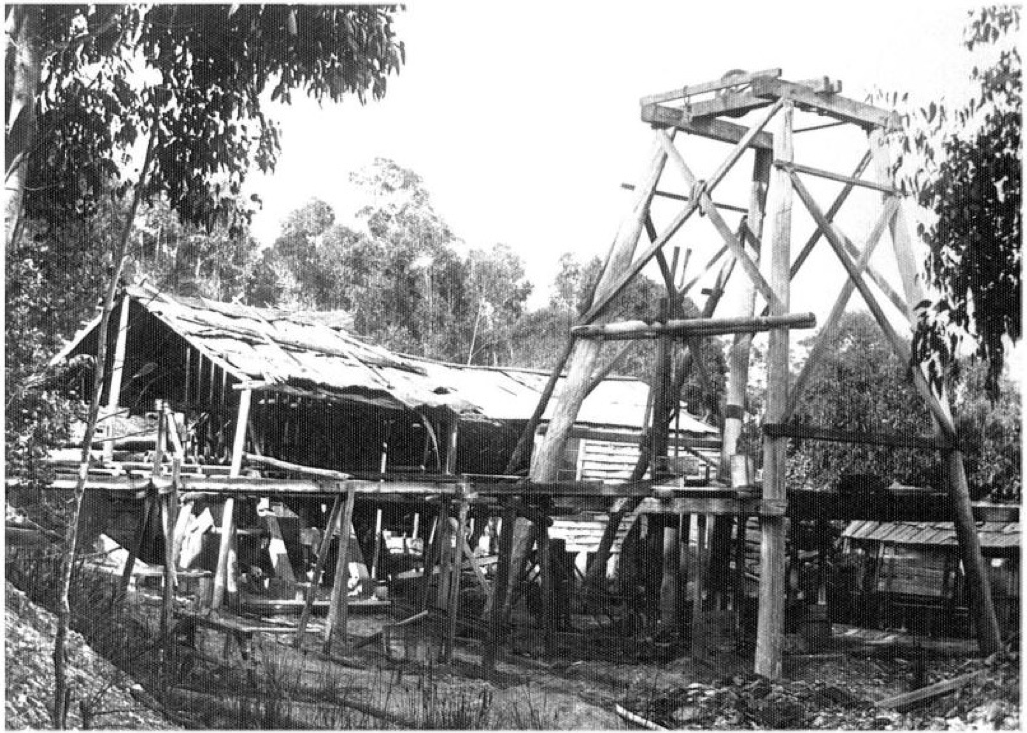
Christina Mine At Clonbinane
Possibly named after Christina McDonald, an early settler of the district.
Christina McDonald had a grand daughter named Gertrude McDonald. Her primary education was at Sunday Creek School No. 3293. The Sunday Creek School was located on Sunday Creek at the old Wandong-Broadford Road, which now is the extension of Spur Road before turning right to cross Sunday Creek at Wall Crossing. It was in this area that the Country Roads Board Camp was set up for the building of the Hume Freeway in 1972.
In 1898 there was 25 students on the roll at Sunday Creek State School . Around 1930 the school operated part time along with Upper Sunday Creek No. 1653 (Clonbinane).This was due to dwindling student numbers.
Gertrude McDonald was the last teacher at both schools.
However, Clonbinane School No.1653 later reopened and moved from Smedleys Lane to a new location closer to the Clonbinane township and mines.
The Clonbinane School No. 1653 closed in 1916 and then re-opened in 1929. The final closure occurred on 8 June in 1948.
You can still see where the school was situated by the presence of Oak trees. After the school closed, the land was sold to Captain Arthur Jowett for it to be included as a part of the Clonbinane Park property. Southern Cross Gold hold stewardship over the Clonbinane State School site; the land is part of Clonbinane Park property.
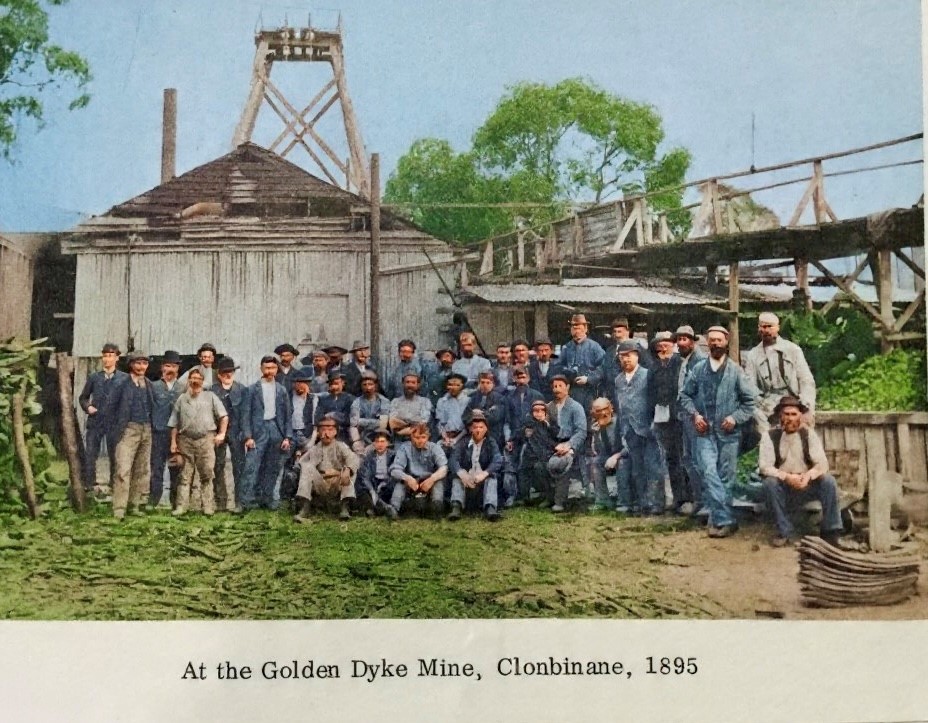
At the Golden Dyke Mine, Clonbinane, 1895 - State Library of Victoria (AI colourisation applied)
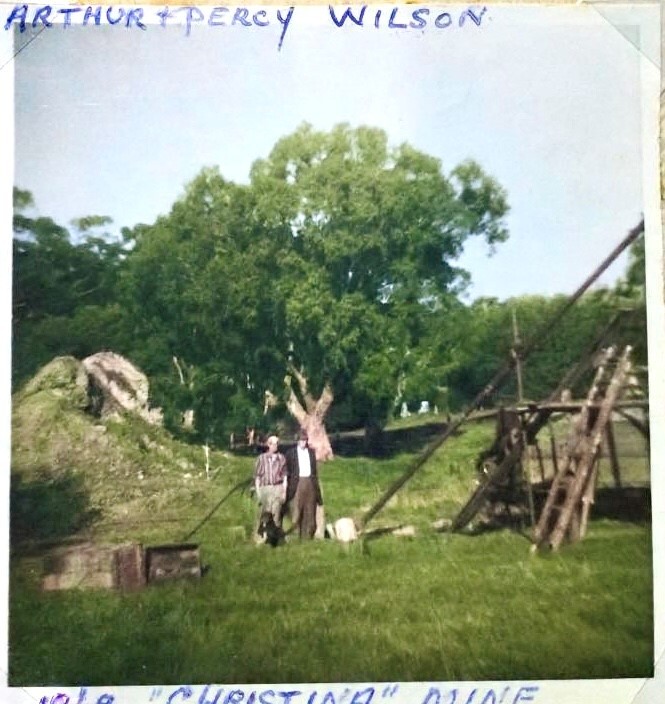
Arthur and Percy Wilson at Christina mine - Di Vidal Collection (AI colourisation applied)
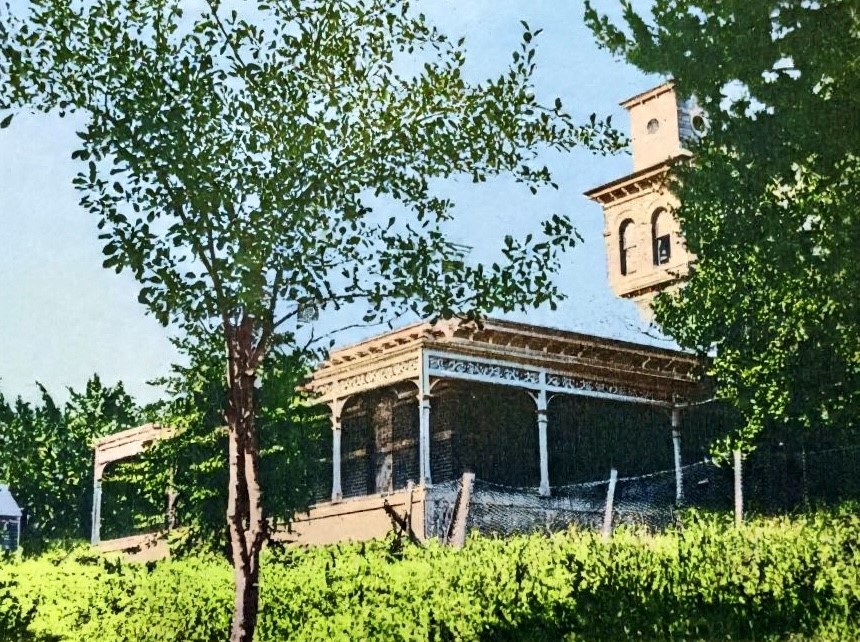
Clonbinane Park - Di Vidal Collection (AI colourisation applied)
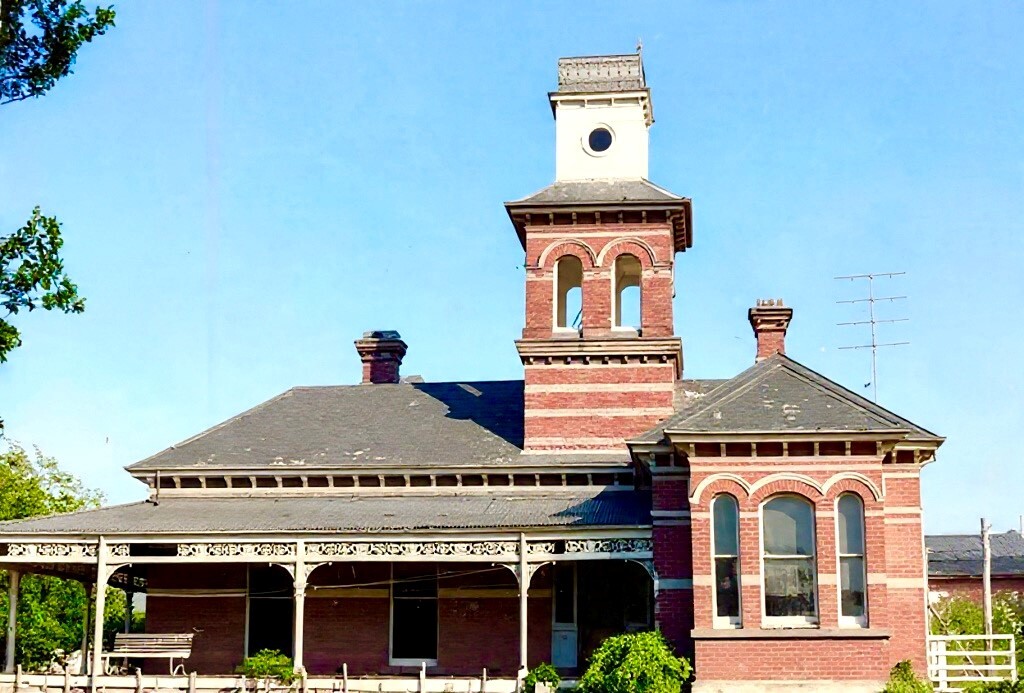
Clonbinane Park 1965 - State Library of Victoria (AI colourisation applied)
